

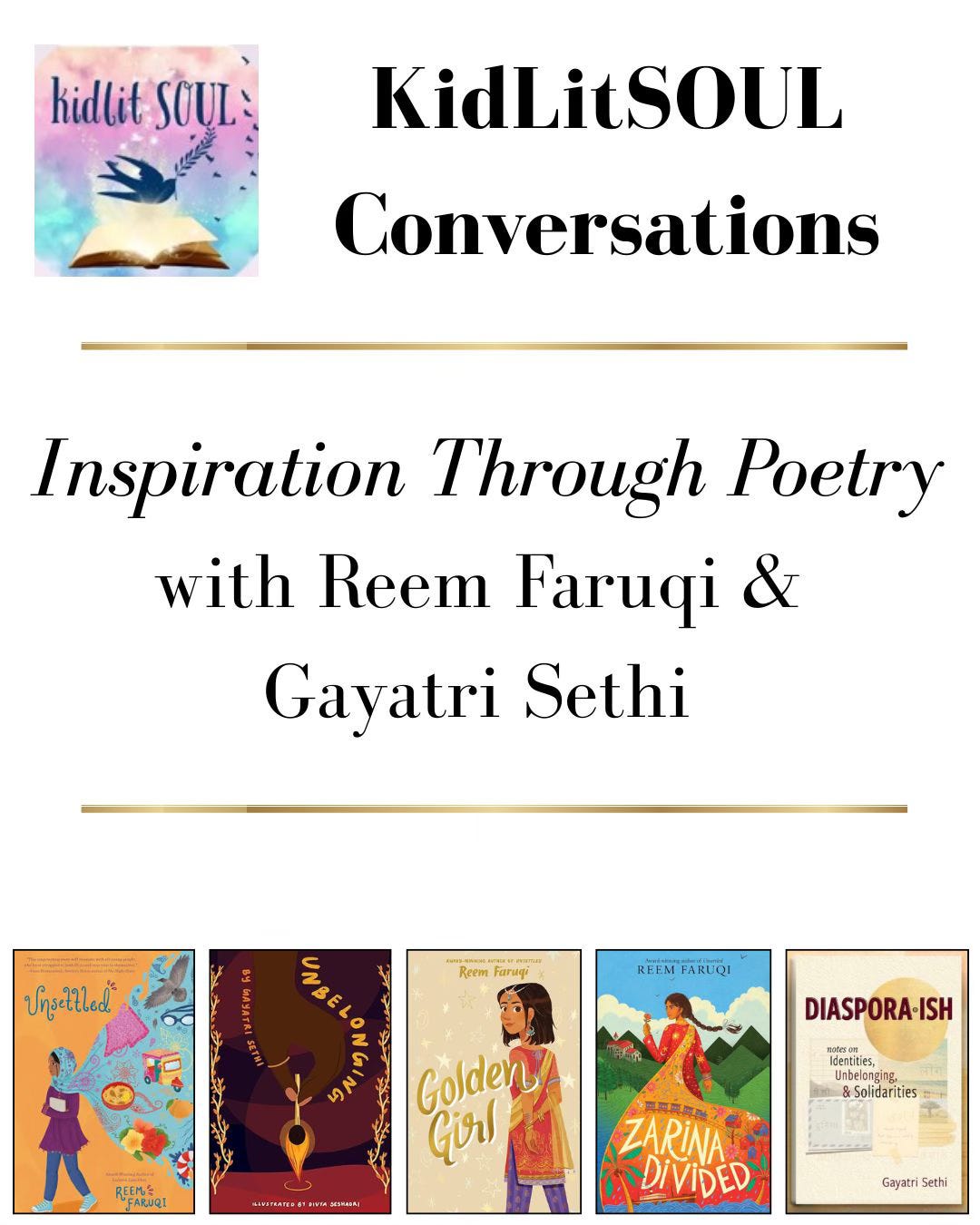
For National Poetry Month, KidLitSOUL welcomes Reem Faruqi and Gayatri Sethi as they discuss the power and inspiration of poetry.
You’ve written several beautiful novels in verse (ZARINA DIVIDED, UNSETTLED, CALL ME ADNAN and GOLDEN GIRL), what inspired you to write poetry?
Thank you! It was accidental at first! I had started my first book UNSETTLED and when I’d sent it to my literary agent at the time, she said it sounded like verse and asked if that was what I intended. I hadn’t but eagerly checked out books at the library and fell in love with verse. I find it an easier format to write in and it’s less intimidating that paragraphs.
Who are poets who inspire your poetry?
There are too many to list! I know Jasmine Warga’s book OTHER WORDS FOR HOME gave me the boost I needed to finish UNSETTLED. It was heartwarming to see a Muslim character like Jude portrayed so beautifully in verse. I also really loved Sandra Cisneros’s writing in THE HOUSE ON MANGO STREET, it showed me how whimsical writing could be. That book really made an impression on me. I still remember how Cisneros describes the different family members hair so vividly and wanting to write like that.
Share your craft tips for writing poetry.
When you’re stuck, which can happen often, step away from your screen and grab a good old pencil or pen, and a regular notebook and write on there. With poetry, the spacing can be playful and intentional so it’s easier to write with a pencil and then transcribe it to a computer document.
Please share a new poem you’ve written recently?
Where are you from? (203 words)
I am a newly turned teen and am new to Peachtree City, Georgia
and any time I see someone Brown
I can’t wait to ask
Where are you from?
And when they answer somewhere a bland town in America
and I follow up No where are you from?
and when they say the state they are from
my eyebrows hug in confusion
No where are you really from?
and when they mention Pakistan India Sri Lanka Bangladesh
anywhere Brown
I smile
feel relief
I am so desperate for a connection of my experience back home
that when they have something that they can share with me
I can say
Me too
Me too
Me too.
Years later
I realize
that you aren’t supposed to ask
Where are you from?
No, where are you really from?
But you see
at that time
I asked
because I so badly wanted to see them
and me
and to have a connection
even it was the slightest whisper
or a trace
where our fingers could point to a map
and land somewhere closer together
than inches and continents
a p a r t.
I could then speak up
Look how our borders touch…
Thank you, Gayatri. I really loved your book Diaspora-ish and think it should be required reading! Your poetry has an emotional punch that we can all learn from.
Reem Faruqi is an award winning author who enjoys writing lyrical stories that reflect her own experiences. When Reem Faruqi taught second grade, her favorite time was “Read Aloud” time. Now, her favorite time at home is reading with her daughters. Reem Faruqi is the award-winning author of Lailah’s Lunchbox, a picture book based on her own experiences as a young Muslim girl immigrating to the United States. Of Pakistani origin, Reem moved to Peachtree City, Georgia, from Abu Dhabi, the United Arab Emirates, when she was 13 years old. She’s also the author of four middle grade novels in verse, Unsettled, Golden Girl, Call Me Adnan, Zarina Divided, chapter book Anisa’s International Day, and picture books Amira’s Picture Day, I Can Help, Milloo’s Mind, Swimming Toward a Dream, House Without Lights, many of which received starred reviews. Reem loves to doodle, write, and take photos at http://www.ReemFaruqi.com. She seasonally worked as a photographer and currently works as a Scheduler for the Islamic Speakers Bureau of Atlanta. Currently, she lives with her husband and four daughters in Atlanta.
Gayatri Sethi is a cultural worker, educator and caregiver. She is connected to multiple diaspora communities in (South) Asia, Africa and the Americas. With heritage roots in pre-partition Punjab, she was born in Shinyanga, Tanzania and raised in Gaborone, Botswana. She identifies as polycultural, multilingual and interfaith.
Her lifelong learning work focuses on unlearning allegiance to systems of oppression rooted in imperialism while relearning about liberation movements, anti-imperialism, abolition, and revolutions. She resides in sacred Muscogee lands and seeks to seed solidarity with movements for land back globally, from Punjab to Palestine.
Thank you!!